Attention this week mostly went to the Pirie sale at Sotheby's, which certainly seemed from my Twitter feed to be the most tweeted-about book auction in recent memory. It was great to see so much interest from around the bibliosphere for this important auction. The total as reported by Sotheby's is $14,908,379, though that does not include after-sale purchases.
- Just hours after the sale, the Folger Shakespeare Library posted a list of their acquisitions: thirty on the floor and another eighteen later.
- The National Library of Ireland was the high bidder on a manuscript and subsequent typescript of Sean O'Casey's Juno and the Paycock, which made $187,500.
- For once, two pieces of good news about the Boston Public Library: the rare books department has reopened following a mold cleanup, and a map stolen by E. Forbes Smiley (but not one of those he admitted to) was returned to the library after being identified by the BPL's map curator. This raises yet more questions about just how forthcoming Smiley really was and how many more maps he stole are still out there.
- The Boston Globe has a long report on the ongoing debate over the so-called "Gospel of Jesus's Wife."
- December's Rare Book Monthly is out, with a report on the recent Boston fairs by Bruce McKinney, a look ahead at this week's Bergé sale, and a piece by Michael Stillman on Richard Stanley Haugh.
- On the Perne & Ward Libraries blog, Ann Eljenholm Nichols posts about the "Cambridge Fish Scribe," who "consistently 'signed' his work by drawing a fish around the catchword(s) written on the last folio of each quire."
- Eve Kahn reports for the NYTimes on Yale's purchase of the Ege collection of manuscripts and fragments.
- Kent-based bookseller Michael Kemp is selling his large collection of works by Mervyn Peake.
- In the November/December issue of Humanities, Richard Brodhead writes about the origins of the NEH and a way forward for the humanities in "On the Fate and Fortunes of Public Goods."
- Duke archivist Tracy Jackson writes about the very amusing collection of material from the Perkins Library suggestion book from the early 1980s.
- James Everest writes for the Royal Society's Repository blog about Robert Hooke's book collection and how he and other early Royal Society members dealt with the works of Athanasius Kircher.
- Jennifer Schuessler reported for the NYTimes about the (re)discovery of a first state King James Bible at Drew University.
- For fans of M.R. James, there's a BBC radio play, "The Midnight House," available now that bears a strong connection to James' story "The Mezzotint" in some respects. And five James stories are also available now for your listening pleasure.
Reviews
- Taschen's new The Book Cover in the Weimar Republic and the Morgan Library's Graphic Passion; review by Peter Mendelsund in the NYTimes.
- Flora Fraser's The Washingtons; review by Annette Gordon-Reed in the NYTimes.
- Jon Meacham's Destiny and Power; review by Steve Donoghue in the CSM.
- Harold Holzer and Norton Garfinkle's A Just and Generous Nation; review by Howell Raines in the WaPo.
- Antonia Fraser's The Pleasure of Reading, Rebecca Rego Barry's Rare Books Uncovered, and Robert Calasso's The Art of the Publisher; review by Michael Dirda in the WaPo. Rare Books Uncovered is also reviewed by Pradeep Sebastian in The Hindu.
- The Meaning of the Library, edited by Alice Crawford; review by Alberto Manguel in the TLS.
- Umberto Eco's Numero Zero; review by Terry Eagleton in the TLS.
Showing posts with label Smiley. Show all posts
Showing posts with label Smiley. Show all posts
Sunday, December 06, 2015
Friday, August 29, 2014
Book Review: "The Map Thief"
I think I have managed to keep a pretty close eye on the media coverage of the E. Forbes Smiley map thefts, his ensuing plea deal and sentencing process, as well as the long aftermath. I even wrote a paper in grad school about the newspaper coverage of the thefts. So I was pleasantly delighted to read Michael Blanding's The Map Thief (Gotham Books, 2014) and find that there was much to the story that hadn't previously made its way into the news in any major way.
Blanding's book, like Miles Harvey's The Island of Lost Maps, probably ought to be required reading for anyone responsible for the cataloging, supervision, curation, collection, purchase, or sale of maps (or even rare printed materials and archives broadly conceived). It tells the story of Smiley's thefts and the ensuing legal wrangling, but Blanding also very carefully treats another important aspect of Smiley's life: his involvement with the interior Maine town of Sebec, which didn't tend to come up much when Smiley was in the news, but which had a major impact on his life and dealings.
Many of the major players in the case spoke to Blanding directly, including former NYPL maps curator Alice Hudson, and the Curator of the Leventhal Map Center at the BPL, Ronald Grim. Many current and former map dealers also spoke to Blanding, as did a whole slew of Smiley's personal friends, as well as Smiley himself (for a brief period). But even with Smiley's perspective, this book in no way turns into a remotely sympathetic portrait (for which see The Man Who Loved Books Too Much). Blanding treats Smiley's crimes with the seriousness they deserve, and makes quite clear the continued concerns among curators at several institutions that prosecutors were too quick to accept a plea deal and did not take seriously enough the post-plea revelations that Smiley had not admitted to all of the thefts.
The book manages to tell a complex story in an extremely readable way, and includes a fair amount of background material on the cartographic history of the maps themselves, the map trade, and how Smiley's actions changed the broader community. Recommended without reservation.
Blanding's book, like Miles Harvey's The Island of Lost Maps, probably ought to be required reading for anyone responsible for the cataloging, supervision, curation, collection, purchase, or sale of maps (or even rare printed materials and archives broadly conceived). It tells the story of Smiley's thefts and the ensuing legal wrangling, but Blanding also very carefully treats another important aspect of Smiley's life: his involvement with the interior Maine town of Sebec, which didn't tend to come up much when Smiley was in the news, but which had a major impact on his life and dealings.
Many of the major players in the case spoke to Blanding directly, including former NYPL maps curator Alice Hudson, and the Curator of the Leventhal Map Center at the BPL, Ronald Grim. Many current and former map dealers also spoke to Blanding, as did a whole slew of Smiley's personal friends, as well as Smiley himself (for a brief period). But even with Smiley's perspective, this book in no way turns into a remotely sympathetic portrait (for which see The Man Who Loved Books Too Much). Blanding treats Smiley's crimes with the seriousness they deserve, and makes quite clear the continued concerns among curators at several institutions that prosecutors were too quick to accept a plea deal and did not take seriously enough the post-plea revelations that Smiley had not admitted to all of the thefts.
The book manages to tell a complex story in an extremely readable way, and includes a fair amount of background material on the cartographic history of the maps themselves, the map trade, and how Smiley's actions changed the broader community. Recommended without reservation.

Sunday, August 17, 2014
Links & Reviews
- Ten years after fire destroyed the Duchess Anna Amalia Library in Weimar, Germany, the library's copy of Copernicus' De revolutionibus, thought destroyed, has been found amongst the many books still being restored, a process which is expected to continue for another 15 years.
- The Smithsonian Institution has launched a crowdsourced transcription interface, to allow volunteers to help transcribe Civil War diaries, field notebooks, and more. There's a short report in the NYTimes.
- The Folger Library has announced that all images in its Digital Image Collection (currently nearly 80,000 items) are now eligible for use under a Creative Commons Attribution-ShareAlike 4.0 International License. Fantastic news!
- Martin Kemp writes on the threats facing the Warburg Institute Library in the Royal Academy Magazine. More coverage on this front from The Guardian.
- UVA Special Collections has acquired a copy of the rare Tolkien publication Songs for the Philologists.
- Many maps stolen by Peter Bellwood from the National Library of Wales remain missing, Wales Online reports.
- On the Provenance Online Project blog, a look at inscriptions partially trimmed off during rebinding.
- It's all pigeons this week over at Confessions of a Bookplate Junkie.
- New (to me, anyway): the Centre for the Study of the Book at Oxford is now posting podcasts of its discussion series.
- Ravi Somaiya profiles Harper's Magazine publisher John R. MacArthur.
- Emory University has launched Readux, a collection of digitized books from their libraries.
- Joshua Holm reviews and recommends Meredith McGill's article "Copyright and Intellectual Property: The State of the Discipline" in Book History 15.
- Michael Blanding talked to David Holahan from the Hartford Courant about his book The Map Thief.
- Anna Da Silva writes about a spat between Anthony Panizzi and the Royal Society for the Society's Repository blog.
- Maurice Sedgwick writes in The Guardian about "What makes Gormenghast a masterpiece?"
- A book cull at the Boston Public Library has hit the news with a report in the Boston Globe. Administrators are, reportedly, "disposing" of 180,000 "little-used volumes" based on circulation statistics.
- Nalo Hopkinson, a professor of Creative Writing at UC Riverside, has posted about concerns over the future of the university's famed science fiction collection.
Reviews
- Adrian Goldsworthy's Augustus; review by Nicholas Shakespeare in The Telegraph.
- Hampton Sides' In the Kingdom of Ice; review by Robert R. Harris in the NYTimes.
- Peter Snow's When Britain Burned the White House; review by Jonathan Yardley in the WaPo.
- The Smithsonian Institution has launched a crowdsourced transcription interface, to allow volunteers to help transcribe Civil War diaries, field notebooks, and more. There's a short report in the NYTimes.
- The Folger Library has announced that all images in its Digital Image Collection (currently nearly 80,000 items) are now eligible for use under a Creative Commons Attribution-ShareAlike 4.0 International License. Fantastic news!
- Martin Kemp writes on the threats facing the Warburg Institute Library in the Royal Academy Magazine. More coverage on this front from The Guardian.
- UVA Special Collections has acquired a copy of the rare Tolkien publication Songs for the Philologists.
- Many maps stolen by Peter Bellwood from the National Library of Wales remain missing, Wales Online reports.
- On the Provenance Online Project blog, a look at inscriptions partially trimmed off during rebinding.
- It's all pigeons this week over at Confessions of a Bookplate Junkie.
- New (to me, anyway): the Centre for the Study of the Book at Oxford is now posting podcasts of its discussion series.
- Ravi Somaiya profiles Harper's Magazine publisher John R. MacArthur.
- Emory University has launched Readux, a collection of digitized books from their libraries.
- Joshua Holm reviews and recommends Meredith McGill's article "Copyright and Intellectual Property: The State of the Discipline" in Book History 15.
- Michael Blanding talked to David Holahan from the Hartford Courant about his book The Map Thief.
- Anna Da Silva writes about a spat between Anthony Panizzi and the Royal Society for the Society's Repository blog.
- Maurice Sedgwick writes in The Guardian about "What makes Gormenghast a masterpiece?"
- A book cull at the Boston Public Library has hit the news with a report in the Boston Globe. Administrators are, reportedly, "disposing" of 180,000 "little-used volumes" based on circulation statistics.
- Nalo Hopkinson, a professor of Creative Writing at UC Riverside, has posted about concerns over the future of the university's famed science fiction collection.
Reviews
- Adrian Goldsworthy's Augustus; review by Nicholas Shakespeare in The Telegraph.
- Hampton Sides' In the Kingdom of Ice; review by Robert R. Harris in the NYTimes.
- Peter Snow's When Britain Burned the White House; review by Jonathan Yardley in the WaPo.
Sunday, May 25, 2014
Links & Reviews
- The Glasgow School of Art's iconic library designed by Charles Rennie Mackintosh was destroyed by a fire this week. You can contribute to a response fund here.
- A plan to close the University of London's Institute of English Studies, outlined here, has been temporarily shelved after a strong scholarly outcry, including more than 3,600 signatures on an online petition.
- Robert Darnton writes in the NYRB about the progress of the DPLA and other projects.
- Brian Cassidy's tenth-anniversary e-catalog, "Mistakes Were Made," is an absolute must-read.
- John Overholt made a fascinating find recently: inked bearer type, which he was then able to identify.
- A book inscribed by Oscar Wilde to prison governor James Nelson as a token of appreciation for giving the author access to reading material could fetch £60,000 when sold at Bonhams in London on 18 June.
- The BL Collection Care blog reports on the recent discovery of a watermark on the rear pastedown of the St. Cuthbert Gospel.
- A.J. O'Shaughnessy has won the 2014 George Washington Book Prize, with its $50,000 purse, for The Men Who Lost America.
- From Aaron Pratt, "Flipping EEBO," a post prompted by a very interesting conversation on Twitter.
- You can now watch the trailer for "Cold Storage," a forthcoming documentary film about the Harvard Depository.
- The Mapping the British Book Trade workshop at Oxford this week made for some lively Twitter chatter, which is documented here.
- At The Collation, Heather Wolfe highlights a wonderful and richly-annotated 1572 dictionary.
- William S. Peterson and Sylvia Holton Peterson have launched a new digital reconstruction of the library of William Morris.
- Caleb Crain responds to the abandonment of the NYPL's Central Library Plan.
- From the Smithsonian Libraries Unbound blog, a look at binding waste found in book spines.
- The NYTimes Bits blog covers the current battle between Amazon and Hachette. Utterly ridiculous for Amazon to be doing this; it just makes them look stupid and petty.
- The HRC has acquired the archive of author Ian McEwan. Along the same vein, see Tim Parks' NYRB essay on author archives.
- Walter Isaacson's NEH Jefferson Lecture "The Intersection of the Humanities and the Sciences" is well worth a read.
- Several books believed to be rebound in decorative cloth by Dorothy Wordsworth were sold for £5,800 at Dreweatts this week.
- The BL's new Romantics and Victorians section of their Discovering Literature website was highlighted in The Guardian.
- Sarah Dry talked to Wired about her new book The Newton Papers.
- John Overholt's put up an animated gif of 19th-century progressive color printing processes.
- Another excellent response to Adam Kirsch's TNR piece on DH (linked in my last post), by Anne Burdick, Johanna Drucker, Peter Lunenfeld, Todd Presner, and Jeffrey Schnapp.
- Colby College's plan to move books out of the stacks is panned in Slate by Rebecca Schuman.
- Larry McMurtry writes on "The Lost Booksellers of New York" in the NYTimes.
- There's an excerpt of Michael Blanding's book on E. Forbes Smiley, The Map Thief, in the Boston Globe Magazine.
- One of my favorite characters, William Jenks, showed up on the AAS blog this week, clothed in books.
- From the University of Melbourne Library Collections blog, "Provenance in Pictures: Tracking the Ownership of Three Early Printed Books."
- Book conservator Samantha Couture is profiled in the Albany Times-Union. Sam does great work, as a few books on my own shelves will attest!
Reviews
- Michael Blanding's The Map Thief; review by Jim Shelton in the New Haven Register.
- Edward St. Aubyn's Lost for Words; review by Jonathan Yardley in the WaPo.
- Michael Waldman's The Second Amendment; review by David Ulin in the LATimes.
- John Leonard's Faithful Laborers; review by Nigel Smith in the TLS.
- Fred Kaplan's John Quincy Adams; reviews by David Shribman in the Boston Globe and Carol Berkin in the WaPo.
- The new edition of Tolkien's translation of Beowulf; review by Craig Williamson in the WSJ.
- Sarah Dry's The Newton Papers; review by Laura Snyder in the WSJ.
- Several alternate histories of the American Revolution are reviewed by Paul Aron at Common-place.
- The Morgan Library exhibition "Gatsby to Garp: Modern Masterpieces from the Carter Burden Collection"; review by Edward Rothstein in the NYTimes.
- A plan to close the University of London's Institute of English Studies, outlined here, has been temporarily shelved after a strong scholarly outcry, including more than 3,600 signatures on an online petition.
- Robert Darnton writes in the NYRB about the progress of the DPLA and other projects.
- Brian Cassidy's tenth-anniversary e-catalog, "Mistakes Were Made," is an absolute must-read.
- John Overholt made a fascinating find recently: inked bearer type, which he was then able to identify.
- A book inscribed by Oscar Wilde to prison governor James Nelson as a token of appreciation for giving the author access to reading material could fetch £60,000 when sold at Bonhams in London on 18 June.
- The BL Collection Care blog reports on the recent discovery of a watermark on the rear pastedown of the St. Cuthbert Gospel.
- A.J. O'Shaughnessy has won the 2014 George Washington Book Prize, with its $50,000 purse, for The Men Who Lost America.
- From Aaron Pratt, "Flipping EEBO," a post prompted by a very interesting conversation on Twitter.
- You can now watch the trailer for "Cold Storage," a forthcoming documentary film about the Harvard Depository.
- The Mapping the British Book Trade workshop at Oxford this week made for some lively Twitter chatter, which is documented here.
- At The Collation, Heather Wolfe highlights a wonderful and richly-annotated 1572 dictionary.
- William S. Peterson and Sylvia Holton Peterson have launched a new digital reconstruction of the library of William Morris.
- Caleb Crain responds to the abandonment of the NYPL's Central Library Plan.
- From the Smithsonian Libraries Unbound blog, a look at binding waste found in book spines.
- The NYTimes Bits blog covers the current battle between Amazon and Hachette. Utterly ridiculous for Amazon to be doing this; it just makes them look stupid and petty.
- The HRC has acquired the archive of author Ian McEwan. Along the same vein, see Tim Parks' NYRB essay on author archives.
- Walter Isaacson's NEH Jefferson Lecture "The Intersection of the Humanities and the Sciences" is well worth a read.
- Several books believed to be rebound in decorative cloth by Dorothy Wordsworth were sold for £5,800 at Dreweatts this week.
- The BL's new Romantics and Victorians section of their Discovering Literature website was highlighted in The Guardian.
- Sarah Dry talked to Wired about her new book The Newton Papers.
- John Overholt's put up an animated gif of 19th-century progressive color printing processes.
- Another excellent response to Adam Kirsch's TNR piece on DH (linked in my last post), by Anne Burdick, Johanna Drucker, Peter Lunenfeld, Todd Presner, and Jeffrey Schnapp.
- Colby College's plan to move books out of the stacks is panned in Slate by Rebecca Schuman.
- Larry McMurtry writes on "The Lost Booksellers of New York" in the NYTimes.
- There's an excerpt of Michael Blanding's book on E. Forbes Smiley, The Map Thief, in the Boston Globe Magazine.
- One of my favorite characters, William Jenks, showed up on the AAS blog this week, clothed in books.
- From the University of Melbourne Library Collections blog, "Provenance in Pictures: Tracking the Ownership of Three Early Printed Books."
- Book conservator Samantha Couture is profiled in the Albany Times-Union. Sam does great work, as a few books on my own shelves will attest!
Reviews
- Michael Blanding's The Map Thief; review by Jim Shelton in the New Haven Register.
- Edward St. Aubyn's Lost for Words; review by Jonathan Yardley in the WaPo.
- Michael Waldman's The Second Amendment; review by David Ulin in the LATimes.
- John Leonard's Faithful Laborers; review by Nigel Smith in the TLS.
- Fred Kaplan's John Quincy Adams; reviews by David Shribman in the Boston Globe and Carol Berkin in the WaPo.
- The new edition of Tolkien's translation of Beowulf; review by Craig Williamson in the WSJ.
- Sarah Dry's The Newton Papers; review by Laura Snyder in the WSJ.
- Several alternate histories of the American Revolution are reviewed by Paul Aron at Common-place.
- The Morgan Library exhibition "Gatsby to Garp: Modern Masterpieces from the Carter Burden Collection"; review by Edward Rothstein in the NYTimes.
Sunday, August 11, 2013
Links & Reviews
Okay, one last gigantic links roundup and then with any luck at all I'll be back to a (slightly-more) regular schedule. I'm back at home now after the summer at Rare Book School, which was wonderful but very busy (hence the lack of posts). I had the great pleasure of taking Jan Storm van Leeuwen's Introduction to the History of Bookbinding course this year, and enjoyed the experience immensely (add it to your list, if it's not on there already). But that was just one of many highlights of the summer.
- Speaking of Rare Book School, Rebecca Rego Barry's "Letter from Rare Book School" is a must-read.
- One of the other students from my RBS class, James Capobianco, has begun posting images of neat bindings from the Houghton collections here.
- Gregory S. Girolami, Professor of Chemistry at the University of Illinois, is conducting a census of the first edition of Robert Boyle's Sceptical Chymist (1661), and is looking for information on extant copies. Contact details are listed on Girolamni's website (and I've written often, I am a huge proponent of book censuses, so I encourage you to help if you can).
- The excellent Community Libraries project has issued a call for papers for three two-day colloquia in 2014 and 2015, which I suspect many readers will be interested in. Please do take a look and distribute widely.
- Via Mitch Fraas, a list of the books Lincoln checked out of the Library of Congress while president.
- Over at Confessions of a Bookplate Junkie, Lew Jaffe explores the question of just what is the earliest American bookplate?
- An absolutely stupendous discovery was made this summer in the collections of Houghton Library: cataloger Karen Nipps found eight original 1767 subscription sheets signed by some 650 Bostonians pledging support of a boycott of British goods in response to the Townshend Acts. J.L. Bell comments on the find here.
- The FBI has posted images of 28 rare books and maps stolen by E. Forbes Smiley and not yet returned to their owners. Do you know where these belong?
- There was a well-worth-reading Reed Johnson piece on the Voynich Manuscript in the New Yorker back in July. Paul Romaine's response to the article shouldn't be missed, either. Johnson talked to NPR about the manuscript as well.
- Stephen Moss of The Guardian talked with Arnold (A.D.) Harvey, the man responsible for creating a fictitious meeting between Dickens and Dostoyevsky that was accepted as fact for years (exposed by Eric Naiman in the TLS in April). Fascinating article.
- The criminal conspiracy trial of Marino Massimo de Caro and his co-conspirators has been delayed until October.
- The ABAA blog noted the discovery of a Pearl Buck manuscript novel in a Texas storage locker.
- Ann Blair's 31 January talk at Columbia, "Methods of Collaboration Among Early Modern Humanists," is now available on YouTube.
- The Harry Ransom Center has acquired the McSweeney's archive.
- The John Carter Brown Library has uploaded its 5000th book to the Internet Archive (theirs is one of the best uses of the Archive I've seen).
- Pop star Kelly Clarkson was the winning bidder on the Jane Austen ring which sold last year at auction for better than £150,000, but the British government is seeking to stop the ring's removal from the country. UK buyers have until 30 September to raise the funds to match Clarkson's bid.
- Information on recent thefts of maps, posted on Ex-Libris in July: "The Chicago Division of the Federal Bureau of Investigation (FBI) is investigating the theft of historical topographical maps from various educational institutions. The maps are mostly from Central and Eastern Europe, including: Poland, Germany, Austria, and western Russia and their scales vary between 1:25,000 to 1:100,000. The maps are considered to be Interwar, meaning they were published between 1919 and 1939. Of particular interest are maps published by the Wojskowy Instytut Geograficzny Instytut (Poland). The investigation has also revealed the theft of 19th century Austro-Hungarian topographical maps. The thefts have occurred as far back as 2008 and as recently as the spring of 2013. The FBI would like to identify as many victims as possible, and would like to interview individuals who may have been in contact with the individual or individuals responsible for these thefts. If you have information or believe your institution may have been the victim of a similar theft, please contact Special Agent Luigi Mondini at 312 829-5526 or luigi.mondini@ic.fbi.gov."
- Two books stolen from the National Library of Sweden by former librarian Anders Burius were returned to the library in late July, after the Baltimore dealer who purchased them at a German auction in 2008 bought them back from the clients to whom he had subsequently sold them.
- The investigation into the 2007 murder of book collector Rolland Comstock remains open, investigators say, even after the recent death of Comstock's ex-wife, found liable for his death in a civil suit. Greene County, MO sheriff Jim Arnott said that charges are still forthcoming related to the case.
- The Onion recently ran an obituary for print.
- From the Cambridge Incunabula Project blog, some unidentified provenance marks discovered in English incunables.
- Mount Vernon and the Fred W. Smith National Library for the Study of George Washington purchased the eight volumes from George Washington's library up for sale in June.
- Richard Luscombe reported for the Guardian on the sale of the Harrisburg collection of memorabilia. Normally I'd be completely appalled at a sale like this, but in this particular case, it seems to have been acquired haphazardly and without much thought, so better for the material to find more appropriate homes.
- Over on the Royal Society's blog, Rebecca Easey writes on the "crossroads between science and art," scientific illustration.
- The winners of the 2013 National Collegiate Book Collecting contest have been announced. Congratulations to all!
- From Matthew Green at the Public Domain Review, "The Lost World of the London Coffeehouse."
- There are Q&As with new Folger Director of Digital Access Eric Johnson and Research and Outreach Librarian Melanie Dyer at The Collation. And at Wynken de Worde, Sarah Werner discusses her new role as the Folger's Digital Media Strategist, which sounds tremendously exciting and awesome.
- A Poe manuscript sold for $300,000 at a small Rhode Island auction on 30 July.
- Over at Boston 1775, J.L. Bell takes a look at Alexander Gilles' editing of his copy of Isaac Watts' Psalms and edited out the British bits.
- John K. Hale, co-editor of a new edition of Milton's De Doctrina Christiana, reflects on the experience for the OSEO blog.
- At Mapping Books, Mitch Fraas posts about his research into print/book circulation between late 18th-century India and Europe, with some great visualizations. In a separate post, Mitch maps the current locations of 15-century books, with some very surprising results.
- The Yale Law Library Rare Books Blog has a new URL: http://library.law.yale.edu/blogs/rare-books.
- Back in July, the NYTimes covered (somewhat anecdotally, by necessity) Amazon's price-shifting practices.
- I almost can't believe that it's been more than four years now since John Quincy Adams started tweeting. The MHS blog has a look back. Thanks to Nancy Heywood and all the others at MHS who have kept the project going!
- Historian Edmund S. Morgan died in early July at the age of 97. The NYTimes ran a thorough obituary. The Junto ran a weeklong roundtable discussion on Morgan's life and legacy.
- From Res Obscura, a beginner's guide to reading early modern texts.
- The British Library has announced plans to bring together all four surviving original copies of the Magna Carta in 2015, to mark the charter's 800th anniversary.
- The Papers of the Bibliographical Society of Canada are now (save the last three years) freely available online.
- William Blake's cottage in Felpham, West Sussex, is for sale.
- Some interesting background on the linguistic unmasking of J.K. Rowling as Robert Galbraith, the author of The Cuckoo's Calling: WSJ blog, Language Log (Patrick Juola).
- In the Boston Globe this weekend, Christine Woodside writes about Laura Ingalls Wilder and her daughter Rose Wilder Lane's intentional crafting of the Little House books to enhance a libertarian political philosophy.
Reviews
- Anthony Pagden's The Enlightenment and Why It Still Matters; review by Noel Malcolm in the Telegraph.
- Scott Anderson's Lawrence in Arabia; review by Alex von Tunzelmann in the NYTimes.
- Royce Prouty's Stoker's Manuscript; review by Rebecca Rego Barry at Fine Books Blog.
- Robert Wilson's Matthew Brady; reviews by Caleb Crain in the NYTimes; Dwight Garner in the NYTimes.
- Boris Kachka's Hothouse; review by Heller McAlpin in the LATimes.
- Samantha Shannon's The Bone Season; review by Helen Brown in the Telegraph.
- Travis McDade's Thieves of Book Row; review by Stephen J. Gertz at Booktryst.
- Brenda Wineapple's Ecstatic Nation; reviews by Scott Martelle in the LATimes; David Reynolds in the NYTimes.
- Caleb Crain's Necessary Errors; review by Aaron Hamburger in the NYTimes.
- Speaking of Rare Book School, Rebecca Rego Barry's "Letter from Rare Book School" is a must-read.
- One of the other students from my RBS class, James Capobianco, has begun posting images of neat bindings from the Houghton collections here.
- Gregory S. Girolami, Professor of Chemistry at the University of Illinois, is conducting a census of the first edition of Robert Boyle's Sceptical Chymist (1661), and is looking for information on extant copies. Contact details are listed on Girolamni's website (and I've written often, I am a huge proponent of book censuses, so I encourage you to help if you can).
- The excellent Community Libraries project has issued a call for papers for three two-day colloquia in 2014 and 2015, which I suspect many readers will be interested in. Please do take a look and distribute widely.
- Via Mitch Fraas, a list of the books Lincoln checked out of the Library of Congress while president.
- Over at Confessions of a Bookplate Junkie, Lew Jaffe explores the question of just what is the earliest American bookplate?
- An absolutely stupendous discovery was made this summer in the collections of Houghton Library: cataloger Karen Nipps found eight original 1767 subscription sheets signed by some 650 Bostonians pledging support of a boycott of British goods in response to the Townshend Acts. J.L. Bell comments on the find here.
- The FBI has posted images of 28 rare books and maps stolen by E. Forbes Smiley and not yet returned to their owners. Do you know where these belong?
- There was a well-worth-reading Reed Johnson piece on the Voynich Manuscript in the New Yorker back in July. Paul Romaine's response to the article shouldn't be missed, either. Johnson talked to NPR about the manuscript as well.
- Stephen Moss of The Guardian talked with Arnold (A.D.) Harvey, the man responsible for creating a fictitious meeting between Dickens and Dostoyevsky that was accepted as fact for years (exposed by Eric Naiman in the TLS in April). Fascinating article.
- The criminal conspiracy trial of Marino Massimo de Caro and his co-conspirators has been delayed until October.
- The ABAA blog noted the discovery of a Pearl Buck manuscript novel in a Texas storage locker.
- Ann Blair's 31 January talk at Columbia, "Methods of Collaboration Among Early Modern Humanists," is now available on YouTube.
- The Harry Ransom Center has acquired the McSweeney's archive.
- The John Carter Brown Library has uploaded its 5000th book to the Internet Archive (theirs is one of the best uses of the Archive I've seen).
- Pop star Kelly Clarkson was the winning bidder on the Jane Austen ring which sold last year at auction for better than £150,000, but the British government is seeking to stop the ring's removal from the country. UK buyers have until 30 September to raise the funds to match Clarkson's bid.
- Information on recent thefts of maps, posted on Ex-Libris in July: "The Chicago Division of the Federal Bureau of Investigation (FBI) is investigating the theft of historical topographical maps from various educational institutions. The maps are mostly from Central and Eastern Europe, including: Poland, Germany, Austria, and western Russia and their scales vary between 1:25,000 to 1:100,000. The maps are considered to be Interwar, meaning they were published between 1919 and 1939. Of particular interest are maps published by the Wojskowy Instytut Geograficzny Instytut (Poland). The investigation has also revealed the theft of 19th century Austro-Hungarian topographical maps. The thefts have occurred as far back as 2008 and as recently as the spring of 2013. The FBI would like to identify as many victims as possible, and would like to interview individuals who may have been in contact with the individual or individuals responsible for these thefts. If you have information or believe your institution may have been the victim of a similar theft, please contact Special Agent Luigi Mondini at 312 829-5526 or luigi.mondini@ic.fbi.gov."
- Two books stolen from the National Library of Sweden by former librarian Anders Burius were returned to the library in late July, after the Baltimore dealer who purchased them at a German auction in 2008 bought them back from the clients to whom he had subsequently sold them.
- The investigation into the 2007 murder of book collector Rolland Comstock remains open, investigators say, even after the recent death of Comstock's ex-wife, found liable for his death in a civil suit. Greene County, MO sheriff Jim Arnott said that charges are still forthcoming related to the case.
- The Onion recently ran an obituary for print.
- From the Cambridge Incunabula Project blog, some unidentified provenance marks discovered in English incunables.
- Mount Vernon and the Fred W. Smith National Library for the Study of George Washington purchased the eight volumes from George Washington's library up for sale in June.
- Richard Luscombe reported for the Guardian on the sale of the Harrisburg collection of memorabilia. Normally I'd be completely appalled at a sale like this, but in this particular case, it seems to have been acquired haphazardly and without much thought, so better for the material to find more appropriate homes.
- Over on the Royal Society's blog, Rebecca Easey writes on the "crossroads between science and art," scientific illustration.
- The winners of the 2013 National Collegiate Book Collecting contest have been announced. Congratulations to all!
- From Matthew Green at the Public Domain Review, "The Lost World of the London Coffeehouse."
- There are Q&As with new Folger Director of Digital Access Eric Johnson and Research and Outreach Librarian Melanie Dyer at The Collation. And at Wynken de Worde, Sarah Werner discusses her new role as the Folger's Digital Media Strategist, which sounds tremendously exciting and awesome.
- A Poe manuscript sold for $300,000 at a small Rhode Island auction on 30 July.
- Over at Boston 1775, J.L. Bell takes a look at Alexander Gilles' editing of his copy of Isaac Watts' Psalms and edited out the British bits.
- John K. Hale, co-editor of a new edition of Milton's De Doctrina Christiana, reflects on the experience for the OSEO blog.
- At Mapping Books, Mitch Fraas posts about his research into print/book circulation between late 18th-century India and Europe, with some great visualizations. In a separate post, Mitch maps the current locations of 15-century books, with some very surprising results.
- The Yale Law Library Rare Books Blog has a new URL: http://library.law.yale.edu/blogs/rare-books.
- Back in July, the NYTimes covered (somewhat anecdotally, by necessity) Amazon's price-shifting practices.
- I almost can't believe that it's been more than four years now since John Quincy Adams started tweeting. The MHS blog has a look back. Thanks to Nancy Heywood and all the others at MHS who have kept the project going!
- Historian Edmund S. Morgan died in early July at the age of 97. The NYTimes ran a thorough obituary. The Junto ran a weeklong roundtable discussion on Morgan's life and legacy.
- From Res Obscura, a beginner's guide to reading early modern texts.
- The British Library has announced plans to bring together all four surviving original copies of the Magna Carta in 2015, to mark the charter's 800th anniversary.
- The Papers of the Bibliographical Society of Canada are now (save the last three years) freely available online.
- William Blake's cottage in Felpham, West Sussex, is for sale.
- Some interesting background on the linguistic unmasking of J.K. Rowling as Robert Galbraith, the author of The Cuckoo's Calling: WSJ blog, Language Log (Patrick Juola).
- In the Boston Globe this weekend, Christine Woodside writes about Laura Ingalls Wilder and her daughter Rose Wilder Lane's intentional crafting of the Little House books to enhance a libertarian political philosophy.
Reviews
- Anthony Pagden's The Enlightenment and Why It Still Matters; review by Noel Malcolm in the Telegraph.
- Scott Anderson's Lawrence in Arabia; review by Alex von Tunzelmann in the NYTimes.
- Royce Prouty's Stoker's Manuscript; review by Rebecca Rego Barry at Fine Books Blog.
- Robert Wilson's Matthew Brady; reviews by Caleb Crain in the NYTimes; Dwight Garner in the NYTimes.
- Boris Kachka's Hothouse; review by Heller McAlpin in the LATimes.
- Samantha Shannon's The Bone Season; review by Helen Brown in the Telegraph.
- Travis McDade's Thieves of Book Row; review by Stephen J. Gertz at Booktryst.
- Brenda Wineapple's Ecstatic Nation; reviews by Scott Martelle in the LATimes; David Reynolds in the NYTimes.
- Caleb Crain's Necessary Errors; review by Aaron Hamburger in the NYTimes.
Sunday, February 14, 2010
Links & Reviews
- Over at bookn3rd, Laura's started a series of posts on birds imagery in medieval manuscripts. I love this sort of thing, and will be waiting impatiently for the next installments.
- Tony Campbell notes that actor Fred Melamed told New York Magazine that he's writing a screenplay based on the Smiley map thefts.
- Countway's Jack Eckert reported on ExLibris this week: "The Center for the History of Medicine has joined with peer libraries to initiate a digital Medical Heritage Library. The Center will receive $400,000 over the next two years to digitize 10,000 rare books from the sixteenth to the twentieth centuries that relate to the intersection of medicine and society. The initiative is funded by a $1.5 million award from the Alfred P. Sloan Foundation to the Open Knowledge Commons, a nonprofit organization dedicated to building a universal digital library for democratic access to information."
- J.L. Bell pours some more cold water on the "Constitution draft" news story that made the rounds last week.
- J.L. Bell pours some more cold water on the "Constitution draft" news story that made the rounds last week.
- From BibliOdyssey, some lovely engravings of moths.
- A great project at Providence Public Library, where Rick Ring reports they're making a database of printer/bookseller/publisher images (about 1,000 of them!).
- There's a new exhibit at the Yale Law School library: "Reused, Rebound, Recovered: Medieval Manuscript Fragments in Law Book Bindings." It will run through May 2010.
- Libraries & the Cultural Record and its predecessor titles (Libraries & Culture and Journal of Library History) are now entirely available through JSTOR (with a subscription).
- Their owner has identified the original plantation ledger and several diaries used by William Faulkner as a source for names and themes in his novels. Sally Wolff-King, a lit professor at Emory, will be publishing a book on the findings in June (Ledgers of History: William Faulkner, an Almost Forgotten Friendship, and an Antebellum Diary). The original documents are now held at the University of North Carolina.
Reviews
- Marilyn Johnson, This Book is Overdue: review in the Boston Globe.
- Mary Beard, It's a Don's Life: review by Anthony Grafton in The New Republic.
- Libraries & the Cultural Record and its predecessor titles (Libraries & Culture and Journal of Library History) are now entirely available through JSTOR (with a subscription).
- Their owner has identified the original plantation ledger and several diaries used by William Faulkner as a source for names and themes in his novels. Sally Wolff-King, a lit professor at Emory, will be publishing a book on the findings in June (Ledgers of History: William Faulkner, an Almost Forgotten Friendship, and an Antebellum Diary). The original documents are now held at the University of North Carolina.
Reviews
- Marilyn Johnson, This Book is Overdue: review in the Boston Globe.
- Mary Beard, It's a Don's Life: review by Anthony Grafton in The New Republic.
- Woody Holton, Abigail Adams: review by Rosemary Zagarri in the Washington Post.
- Kathryn Allamong Jacob, King of the Lobby: review by Jonathan Yardley in the Washington Post.
- Michael Kranish, Flight from Monticello; review by Robert K. Landers in the WSJ.
- Samuel Cohn, Jr., Cultures of Plague; review by Lauro Martines in the TLS.
- Peter Carey, Parrot and Olivier in America: reviews by Robert Epstein in the Independent; Lucy Daniel in the Telegraph; Andrew Taylor, also in the Independent.
Saturday, January 16, 2010
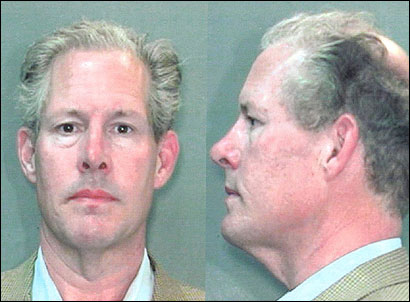
Hang Onto Your Maps, Folks!
 Everett Wilkie confirms that convicted map thief E. Forbes Smiley was released yesterday, 15 January 2010.
Photo from Boston.com.
Saturday, September 12, 2009
Smiley Release Date Set
Convicted map thief E. Forbes Smiley is scheduled for release in early 2010, Everett Wilkie reports on Ex-Libris:
"According to the U.S. Prison at Devens, MA, E. Forbes Smiley is to be released from that prison and sent to a half-way house, the Barnstable County Work Release Center, in Bourne, MA, on September 22. He is scheduled to be released completely from custody on January 17, 2010."
"According to the U.S. Prison at Devens, MA, E. Forbes Smiley is to be released from that prison and sent to a half-way house, the Barnstable County Work Release Center, in Bourne, MA, on September 22. He is scheduled to be released completely from custody on January 17, 2010."
Sunday, February 08, 2009
Links & Reviews
- In the Boston Globe, Erin McKean profiles the strange and ever-evolving Twitterverse (I will say, it's much more addictive than I thought it would be).
- A cabinet of Alfred Russel Wallace's biological specimens has turned up in a D.C. lawyer's home, the Washington Post notes today.
- Ian (among others) pointed out Save the Words this week: an effort to get little-used words into normal conversation.
- Rick Ring reports a really neat find at the Providence Public Library: a piece of the shirt collar of Maj. Sullivan Ballou, whose famous final letter to his wife Sarah was featured so prominently on Ken Burns' Civil War documentary (and has become forever linked to the beautiful "Ashokan Farewell" music in my head).
- The Times ran a story this week on the UK's most stolen books (as determined by a straw poll of 50 independent booksellers): the winner was London A-Z. The piece also comments on some library thefts. [h/t Shelf:Life]
- Nick Basbanes recommends two new Darwin books to read for the bicentennial, and mourns the loss of Ron Ravneberg, a famed collector of James Cook materials and a founding member of the Aldus Society.
- Reading Copy notes the discovery of a Library of Congress book at the John F. Kennedy Library; Kennedy had checked out the book (a biography of Lincoln) while a senator and never returned it. The book will be displayed at the JFK Library through Presidents' Day, and then will be returned to DLC.
- Tim has some stats on where LT's records come from and how they're used. Good stuff.
- The American Historical Review has rejected the controversial article criticizing Stanley Kutler's published version of the Nixon tapes. In a response to the author, AHR editor Robert Schneider said that the essay, "despite its intrinsic interest, is too narrow in focus for this publication. ... Essays must therefore reach beyond the issues, concerns or jargon of a particular sub-field and speak to larger theoretical, methodological, or substantive issues. It seems to us that your essay is more appropriately placed in a more specialized journal." Author Peter Klingman told the NYTimes he is considering what steps to take next.
- Laura has an account of her recent trip to Antwerp, where she visited the Plantin-Moretus Museum. Sounds like a great trip, and the pictures are beautiful!
- J.L. Bell throws a little cold water on the "hot Martha Washington" item I mentioned earlier this week. Bell's also begun a new series of CSI:Colonial Boston in recent days, and continues to uncover intriguing things.
- GalleyCat lists some good publisher blogs.
- Chris catches a great library story: the pilot who ditched his plane in the Hudson had a library book in his luggage, and the library has not only agreed to waive the replacement costs, but has dedicated the new copy to Mr. Sullenberger.
- Former Manhattan prosecutor turned crime novelist Linda Fairstein has turned to recent map theft cases for her latest book, Lethal Legacy, in which the thief is called Eddy Forbes (and is based in part on E. Forbes Smiley).
- Rare Book Review notes a new gimmick from the BL: an adopt-a-book scheme centered on Valentine's Day.
- In the NYTimes, Blake Wilson has some "Stray Questions" for Steven Johnson, in which he comments briefly on his use of Google Books for his most recent book, The Invention of Air.
Reviews
- In the LATimes, M.G. Lord reviews a whole slew of new books on Darwin (and some whacky offshoots of his ideas).
- Malcolm C. Lyons, with Ursula Lyons; the tales are introduced and annotated by Robert Irwin.
- Walter Olson reviews David Liss' Whiskey Rebels in the NYTimes.
- Steven Gunn reviews several new books on Henry VIII as the 500th anniversary of his accession approaches.
- For the Times, Roy Hattersley reviews Doris Kearns Goodwin's Team of Rivals.
- In the NYRB, Frank Kermode reviews a trio of new Milton biographies.
- Richard Cox reviews Ann Laura Stoler's Across the Archival Grain and Peter Charles Hoffer's The Historian's Paradox.
- A cabinet of Alfred Russel Wallace's biological specimens has turned up in a D.C. lawyer's home, the Washington Post notes today.
- Ian (among others) pointed out Save the Words this week: an effort to get little-used words into normal conversation.
- Rick Ring reports a really neat find at the Providence Public Library: a piece of the shirt collar of Maj. Sullivan Ballou, whose famous final letter to his wife Sarah was featured so prominently on Ken Burns' Civil War documentary (and has become forever linked to the beautiful "Ashokan Farewell" music in my head).
- The Times ran a story this week on the UK's most stolen books (as determined by a straw poll of 50 independent booksellers): the winner was London A-Z. The piece also comments on some library thefts. [h/t Shelf:Life]
- Nick Basbanes recommends two new Darwin books to read for the bicentennial, and mourns the loss of Ron Ravneberg, a famed collector of James Cook materials and a founding member of the Aldus Society.
- Reading Copy notes the discovery of a Library of Congress book at the John F. Kennedy Library; Kennedy had checked out the book (a biography of Lincoln) while a senator and never returned it. The book will be displayed at the JFK Library through Presidents' Day, and then will be returned to DLC.
- Tim has some stats on where LT's records come from and how they're used. Good stuff.
- The American Historical Review has rejected the controversial article criticizing Stanley Kutler's published version of the Nixon tapes. In a response to the author, AHR editor Robert Schneider said that the essay, "despite its intrinsic interest, is too narrow in focus for this publication. ... Essays must therefore reach beyond the issues, concerns or jargon of a particular sub-field and speak to larger theoretical, methodological, or substantive issues. It seems to us that your essay is more appropriately placed in a more specialized journal." Author Peter Klingman told the NYTimes he is considering what steps to take next.
- Laura has an account of her recent trip to Antwerp, where she visited the Plantin-Moretus Museum. Sounds like a great trip, and the pictures are beautiful!
- J.L. Bell throws a little cold water on the "hot Martha Washington" item I mentioned earlier this week. Bell's also begun a new series of CSI:Colonial Boston in recent days, and continues to uncover intriguing things.
- GalleyCat lists some good publisher blogs.
- Chris catches a great library story: the pilot who ditched his plane in the Hudson had a library book in his luggage, and the library has not only agreed to waive the replacement costs, but has dedicated the new copy to Mr. Sullenberger.
- Former Manhattan prosecutor turned crime novelist Linda Fairstein has turned to recent map theft cases for her latest book, Lethal Legacy, in which the thief is called Eddy Forbes (and is based in part on E. Forbes Smiley).
- Rare Book Review notes a new gimmick from the BL: an adopt-a-book scheme centered on Valentine's Day.
- In the NYTimes, Blake Wilson has some "Stray Questions" for Steven Johnson, in which he comments briefly on his use of Google Books for his most recent book, The Invention of Air.
Reviews
- In the LATimes, M.G. Lord reviews a whole slew of new books on Darwin (and some whacky offshoots of his ideas).
- Malcolm C. Lyons, with Ursula Lyons; the tales are introduced and annotated by Robert Irwin.
- Walter Olson reviews David Liss' Whiskey Rebels in the NYTimes.
- Steven Gunn reviews several new books on Henry VIII as the 500th anniversary of his accession approaches.
- For the Times, Roy Hattersley reviews Doris Kearns Goodwin's Team of Rivals.
- In the NYRB, Frank Kermode reviews a trio of new Milton biographies.
- Richard Cox reviews Ann Laura Stoler's Across the Archival Grain and Peter Charles Hoffer's The Historian's Paradox.
Tuesday, October 14, 2008
Nope, Not Harvard's Champlain Map
By way of update to yesterday's story, Harvard officials have determined that the 1612 Champlain map scheduled for sale at Sotheby's is not the one missing from their collections. Canwest News Service reports a statement from Harvard spokesperson Beth Brainard saying that curators "have found enough discrepancies to believe that the one for sale is not the one missing from Harvard."
Monday, October 13, 2008
Stolen Harvard Map at Sotheby's?
A rare 1612 Champlain map of Canada scheduled to be sold at Sotheby's next month may be the copy missing from Harvard's library, according to news reports. The map, titled "Carte Geographiqve de la Novvelle Franse faictte par le Sievr de Champlain ...," "was the first published map to show Montreal, Lake Champlain and the Great Lakes as a chain of connected waterways." Sotheby's calls it "perhaps the most important single map in the history of Canada." The auction house estimate on the map stands at 30,000-40,000 GBP.
Harvard's copy of the map was discovered missing during the aftermath of the Smiley thefts, and is included in an August 2006 list of missing maps. Smiley did not admit to taking this particular map, but as we know that doesn't necessarily mean he didn't do so. Harvard curators are "comparing the Sotheby's map to a digital image of Houghton's missing map," said a university spokesperson, adding "we may need to send someone to London, to look at the map."
Sotheby's says the map was checked against a database of lost and stolen art before being accepted for sale. Tony Campbell adds "Clearly Sotheby's are unaware of the efforts made to identify and then publicise the maps found missing in those collections visited by Smiley, information brought together by John Woram into a single database. That the large number of those maps still unaccounted for are not also included in the new database, specifically for maps, set up by IAMA, is not for want of urging by Joel Kovarsky, who manages that vital tool in the fight against thefts."
We should know soon enough whether or not this is Harvard's map, provided that they actually do have good digital images of their copy. So, as they say, stay tuned.
Harvard's copy of the map was discovered missing during the aftermath of the Smiley thefts, and is included in an August 2006 list of missing maps. Smiley did not admit to taking this particular map, but as we know that doesn't necessarily mean he didn't do so. Harvard curators are "comparing the Sotheby's map to a digital image of Houghton's missing map," said a university spokesperson, adding "we may need to send someone to London, to look at the map."
Sotheby's says the map was checked against a database of lost and stolen art before being accepted for sale. Tony Campbell adds "Clearly Sotheby's are unaware of the efforts made to identify and then publicise the maps found missing in those collections visited by Smiley, information brought together by John Woram into a single database. That the large number of those maps still unaccounted for are not also included in the new database, specifically for maps, set up by IAMA, is not for want of urging by Joel Kovarsky, who manages that vital tool in the fight against thefts."
We should know soon enough whether or not this is Harvard's map, provided that they actually do have good digital images of their copy. So, as they say, stay tuned.
Thursday, July 10, 2008
What's Wrong With This Picture?
Thomas Pilaar, 34, has been sentenced to pay fines of $53,549 and serve ten years in state prison after pleading guilty to stealing more than 1,400 books and DVDs from libraries in the Denver, Colorado area.
The AP reports "Pilaar was accused of using his own and other people's library cards from Denver, Douglas County, Aurora and Littleton to check out [library materials], which he later sold on Craigslist. About 1,400 books and DVDs were taken by Pilaar, of which only 500 items were recovered. The restitution covers the amount of losses suffered by all the victimized libraries. Denver Public Library last year estimated its losses at $35,000, while Douglas County reported that Pilaar had $11,000 worth of overdue materials, mostly pricey coffee-table books and DVDs."
Pilaar was arrested on unrelated charges last August.
E. Forbes Smiley, who stole at least 100 rare maps from major cultural institutions in the United States and Britain, was sentenced to 42 months in federal prison (and ordered to pay $2.3 million in restitution). Sure, the fine is higher, but half the prison time for what was a much more serious cultural crime?
Don't get me wrong: I'm pleased as punch that Pilaar will be spending some serious time behind bars. But what Smiley stole, frankly, is worth a great deal more, culturally (and fiscally) speaking, than the "coffee-table books and DVDs" Pilaar was making off with. I guess we ought to make it a rule that all federal prosecutors come from Colorado, or something ...
The AP reports "Pilaar was accused of using his own and other people's library cards from Denver, Douglas County, Aurora and Littleton to check out [library materials], which he later sold on Craigslist. About 1,400 books and DVDs were taken by Pilaar, of which only 500 items were recovered. The restitution covers the amount of losses suffered by all the victimized libraries. Denver Public Library last year estimated its losses at $35,000, while Douglas County reported that Pilaar had $11,000 worth of overdue materials, mostly pricey coffee-table books and DVDs."
Pilaar was arrested on unrelated charges last August.
E. Forbes Smiley, who stole at least 100 rare maps from major cultural institutions in the United States and Britain, was sentenced to 42 months in federal prison (and ordered to pay $2.3 million in restitution). Sure, the fine is higher, but half the prison time for what was a much more serious cultural crime?
Don't get me wrong: I'm pleased as punch that Pilaar will be spending some serious time behind bars. But what Smiley stole, frankly, is worth a great deal more, culturally (and fiscally) speaking, than the "coffee-table books and DVDs" Pilaar was making off with. I guess we ought to make it a rule that all federal prosecutors come from Colorado, or something ...
Wednesday, January 02, 2008
Update on BPL's Stolen Maps
The Boston Globe's Jenna Russell has a story today providing some new details about the number of maps which still remain missing from the Boston Public Library, even as the 31 maps stolen by E. Forbes Smiley have been returned safely to the library's collections. Russell reports that another 34 maps have been discovered missing but have not been linked to Smiley's thefts.
Outgoing BPL pres Bernie Margolis told the paper that Smiley "paid the library $7,000 in restitution for another map he stole that cannot be found," and that one additional map which Smiley lifted has not yet been recovered.
A post-Smiley inventory revealed 36 additional missing maps, two of which have been returned ("by collectors in Boston and Maryland"). "The Boston library has spent about $200,000 on improved security and surveillance systems to prevent future thefts, Margolis said. All visitors to the rare-books room now sign in and out." Well that's a first step, I guess.
At Harvard, all but three of the twelve maps found to be missing from the collections have now returned safely. "Maps still missing from the university include a map of New England, published in a book by English travel writer Samuel Purchas in 1625, that was one of the first to show Cape Cod, and a 1612 map by Samuel de Champlain that was the first to show a chain of Great Lakes, according to Harvard."
Margolis said of the lessons learned by the thefts: "We always felt we could be open and people would not take advantage. We realize now we need to have procedures to keep honest people honest, and to keep dishonest people honest as well."
Good luck with that. It may be well nigh impossible to stop the most determined thieves, but we all must do what we can to make sure that they are either frustrated in their attempts, or - at the very least - are caught and punished to the most severe extent possible.
Outgoing BPL pres Bernie Margolis told the paper that Smiley "paid the library $7,000 in restitution for another map he stole that cannot be found," and that one additional map which Smiley lifted has not yet been recovered.
A post-Smiley inventory revealed 36 additional missing maps, two of which have been returned ("by collectors in Boston and Maryland"). "The Boston library has spent about $200,000 on improved security and surveillance systems to prevent future thefts, Margolis said. All visitors to the rare-books room now sign in and out." Well that's a first step, I guess.
At Harvard, all but three of the twelve maps found to be missing from the collections have now returned safely. "Maps still missing from the university include a map of New England, published in a book by English travel writer Samuel Purchas in 1625, that was one of the first to show Cape Cod, and a 1612 map by Samuel de Champlain that was the first to show a chain of Great Lakes, according to Harvard."
Margolis said of the lessons learned by the thefts: "We always felt we could be open and people would not take advantage. We realize now we need to have procedures to keep honest people honest, and to keep dishonest people honest as well."
Good luck with that. It may be well nigh impossible to stop the most determined thieves, but we all must do what we can to make sure that they are either frustrated in their attempts, or - at the very least - are caught and punished to the most severe extent possible.
Friday, August 03, 2007
Loads of Links
I've got a bumper crop of things I've been saving up to pass along, so without further ado:
- Off the Shelf reports on Scholastic's announcement yesterday that 11.5 million copies of Harry Potter and the Deathly Hallows were sold in the first ten days of release, 8.3 million in the first day alone. And that's just in the U.S.
- Scott Brown notes a piece from the Publisher's Lunch newsletter reporting that Allison Bartlett's book The Man Who Loved Books: The True Story of a Rare Book Thief, a Book Detective, and a World of Literary Obsession, about thief John Charles Gilkey, will be published by Riverhead. Scott's even dredged up a 2006 article by Bartlett about the Gilkey case, which is well worth a read.
- Paper Cuts has some 'stray questions' for author Eric Schlosser, who says he's working on a book about the U.S. prison system.
- From Rare Book Review, news that Shakespeare's Globe and the British Library are teaming up to produce facsimile reprints of individual Shakespeare plays as they appeared in the First Folio; the initial offerings are Othello, The Merchant of Venice and Love's Labour's Lost.
- Travis comments on the Yale Alumni Magazine article I mentioned the other day; he makes a point I'd forgotten, that the article says Smiley will serve five years in prison when in reality he's scheduled to be released in January, 2010.
- Reading Copy announces the ten largest July sales on AbeBooks; at the top was a signed copy of the first American edition of Einstein's Relativity for $12,500.
- From AHA Today, word that the National Archives has made a non-exclusive deal with Amazon subsidiary CustomFlix to produce DVDs of select historic films and newsreels from NARA's holdings. The DVDs, produced on demand from copies stored at CustomFlix, will retail for $19.99. NARA will receive a digital "preservation copy" of each film.
- At Critical Mass, librarian K.G. Schneider writes about the survival of small press journals in a digital environment. It's a good essay, in which she notes "it's one thing to promote access to electronic information as a common good and quite another to insist that a discipline's needs are well-met by replacing a well-known, beloved form with an incomplete, disembodied, fletcherized stream of 'information.'" Quite so.
- Over at Book Patrol, Michael points out some spooky books.
- Joyce points out a YouTube video in which bookbinder Peter Goodwin comments on brittle book syndrome.
- Forrest has the third installment of the Affair of the Diamond Necklace.
- Andrew Ferguson was on NPR recently discussing Land of Lincoln.
- Bookride examines the collectibility of Richard Burton's 1855 book Personal Narrative of a Pilgrimage to El-Medinah and Meccah.
- Off the Shelf reports on Scholastic's announcement yesterday that 11.5 million copies of Harry Potter and the Deathly Hallows were sold in the first ten days of release, 8.3 million in the first day alone. And that's just in the U.S.
- Scott Brown notes a piece from the Publisher's Lunch newsletter reporting that Allison Bartlett's book The Man Who Loved Books: The True Story of a Rare Book Thief, a Book Detective, and a World of Literary Obsession, about thief John Charles Gilkey, will be published by Riverhead. Scott's even dredged up a 2006 article by Bartlett about the Gilkey case, which is well worth a read.
- Paper Cuts has some 'stray questions' for author Eric Schlosser, who says he's working on a book about the U.S. prison system.
- From Rare Book Review, news that Shakespeare's Globe and the British Library are teaming up to produce facsimile reprints of individual Shakespeare plays as they appeared in the First Folio; the initial offerings are Othello, The Merchant of Venice and Love's Labour's Lost.
- Travis comments on the Yale Alumni Magazine article I mentioned the other day; he makes a point I'd forgotten, that the article says Smiley will serve five years in prison when in reality he's scheduled to be released in January, 2010.
- Reading Copy announces the ten largest July sales on AbeBooks; at the top was a signed copy of the first American edition of Einstein's Relativity for $12,500.
- From AHA Today, word that the National Archives has made a non-exclusive deal with Amazon subsidiary CustomFlix to produce DVDs of select historic films and newsreels from NARA's holdings. The DVDs, produced on demand from copies stored at CustomFlix, will retail for $19.99. NARA will receive a digital "preservation copy" of each film.
- At Critical Mass, librarian K.G. Schneider writes about the survival of small press journals in a digital environment. It's a good essay, in which she notes "it's one thing to promote access to electronic information as a common good and quite another to insist that a discipline's needs are well-met by replacing a well-known, beloved form with an incomplete, disembodied, fletcherized stream of 'information.'" Quite so.
- Over at Book Patrol, Michael points out some spooky books.
- Joyce points out a YouTube video in which bookbinder Peter Goodwin comments on brittle book syndrome.
- Forrest has the third installment of the Affair of the Diamond Necklace.
- Andrew Ferguson was on NPR recently discussing Land of Lincoln.
- Bookride examines the collectibility of Richard Burton's 1855 book Personal Narrative of a Pilgrimage to El-Medinah and Meccah.
Wednesday, August 01, 2007
Yale Article on Sterling Library Maps
Via Everett Wilkie on ExLibris: the July/August Yale Alumni Magazine includes an article on some of the fallout from the Smiley thefts, with a focus on efforts taken at the Sterling Library to upgrade cataloging, security and storage for the rare maps and other items housed there.
Tuesday, July 24, 2007
Editorial Urges Library Security
An editorial in yesterday's Concord Monitor uses the example of E. Forbes Smiley to push for better library security measures:
"Smiley's career led many of the world's premiere libraries to make security improvements, but most smaller institutions, including many in New Hampshire, remain very vulnerable. Libraries that haven't completely cataloged their collections - a box of papers from a famous person, for example - or taken note of the rare maps and prints that can easily be excised from seldom-read books are easy prey for a knowledgeable thief.
The collections of the world's libraries are in trust for all humanity. The challenge for institutions is to make their contents as accessible as possible while simultaneously safeguarding them. That's not easy to do.
"Smiley's career led many of the world's premiere libraries to make security improvements, but most smaller institutions, including many in New Hampshire, remain very vulnerable. Libraries that haven't completely cataloged their collections - a box of papers from a famous person, for example - or taken note of the rare maps and prints that can easily be excised from seldom-read books are easy prey for a knowledgeable thief.
The collections of the world's libraries are in trust for all humanity. The challenge for institutions is to make their contents as accessible as possible while simultaneously safeguarding them. That's not easy to do.
There will never be money enough to provide perfect security or even, perhaps, to catalog every item in a way that makes it accessible to the public online, but the latter effort should be undertaken. Searchable, online catalogs of a library or museum's contents make its easy for honest dealers, other museums, researchers and law enforcement to identify stolen items."
The editorial goes on to urge communities to take advantage of a state grant program which offers up to $10,000 "to improve the storage conditions, security, conservation and microfilming of town records. Every community should take advantage of the program to catalog what they own and to take steps to foil thieves like Smiley."
Tuesday, July 03, 2007
Prosecutor Wants 12-18 Months for McTague
Travis reports on the federal prosecutor's sentencing memorandum in the Denning McTague (aka Thieving Intern) case. I agree entirely with Travis' characterization of the memo's first paragraph: almost all "fantastic ... Right up until the last sentence."
"Defendant Denning McTague, a thief, stole American history. Although educated in history and raised surrounded by historical documents in his mother’s antiquarian business, McTague did not steal these 164 documents from the National Archives because he cherished the importance of the historical event or the character of the document’s author. No, McTague stole the items to place them for sale on ebay, that is to make money. McTague used his knowledge and skills to take advantage of an opportunity and the people that trusted him at the National Archives. For these reasons, as well as for the reasons provided below, the government recommends a sentence of incarceration within the advisory guideline range of 12 to 18 months."
Travis notes "While this doesn't come as a surprise, it still stings a little to see it written out." He's got some more observations about the brief, which includes some Word-induced typographical anomalies (that is, obnoxious manifestations of the auto-correct feature).
The defense brief isn't out yet, but will certainly call for less jail time (or probably none at all); perhaps they'll take a page from the Smiley judge's book and ask for less than a week, since McTague says he snatched all the documents over the course of two days.
McTague's sentencing is set for 12 July at 2:30 p.m.
[Updated to change McDade to McTague in two spots. Sorry Travis!]
"Defendant Denning McTague, a thief, stole American history. Although educated in history and raised surrounded by historical documents in his mother’s antiquarian business, McTague did not steal these 164 documents from the National Archives because he cherished the importance of the historical event or the character of the document’s author. No, McTague stole the items to place them for sale on ebay, that is to make money. McTague used his knowledge and skills to take advantage of an opportunity and the people that trusted him at the National Archives. For these reasons, as well as for the reasons provided below, the government recommends a sentence of incarceration within the advisory guideline range of 12 to 18 months."
Travis notes "While this doesn't come as a surprise, it still stings a little to see it written out." He's got some more observations about the brief, which includes some Word-induced typographical anomalies (that is, obnoxious manifestations of the auto-correct feature).
The defense brief isn't out yet, but will certainly call for less jail time (or probably none at all); perhaps they'll take a page from the Smiley judge's book and ask for less than a week, since McTague says he snatched all the documents over the course of two days.
McTague's sentencing is set for 12 July at 2:30 p.m.
[Updated to change McDade to McTague in two spots. Sorry Travis!]
Wednesday, May 23, 2007
Smiley Restitution Payment Upped
On Tuesday, confessed map thief E. Forbes Smiley was ordered to pay $2.3 million in restitution to the institutions he stole from and the dealers he sold to, the AP reports. That's up from the $1.9 million sum tentatively announced at Smiley's sentencing last September. Unfortunately, just because Smiley was ordered to pay doesn't mean he will - that will depend "on his ability to pay after he gets out of prison and the government's ability to sell his assets."
This restitution figure is based on the 96 maps recovered and four that are known to remain missing; it does not include those maps which Smiley is widely believed to have taken but not admitted.
The AP piece briefly summarizes the Smiley saga, noting that the dealer "offered little explanation for his motives, aside from selfishness. Prosecutors have said he acted out of resentment toward the prestigious libraries and to pay for his expensive tastes and mounting debts."
This restitution figure is based on the 96 maps recovered and four that are known to remain missing; it does not include those maps which Smiley is widely believed to have taken but not admitted.
The AP piece briefly summarizes the Smiley saga, noting that the dealer "offered little explanation for his motives, aside from selfishness. Prosecutors have said he acted out of resentment toward the prestigious libraries and to pay for his expensive tastes and mounting debts."
Monday, March 19, 2007
More on McTague
Several new tidbits of information today on the Denning McTague case:
- The "criminal information" (apparently something like an indictment, but it seems to be less serious, which probably has something to do with McTague's Smiley-like "cooperation") filed against McTague charges him with the theft of 165 archival documents from the National Archives. A press release notes that 161 of the items have been recovered.
- Over at Upward Departure Travis McDade has some more information on the charges, and notes that McTague's guilty plea is scheduled for 4 April. He writes that the charges filed fall under 18 USC 641 (theft of government property) rather than 18 USC 668 (theft of major artwork). This means that if the combined value of McTague's thefts is less than $1000, the only punishment is that the offender "shall be fined under this title or imprisoned not more than one year, or both."
Travis: "Another troubling aspect of the statute is this: 'The word ‘value’ means face, par or market value or cost price, either wholesale or retail, whichever is greater.' This valuation scheme stands in direct opposition to the idea that the value of unique national documents of the sort that McTague stole are worth far more to the culture than just their price on the open market. I simply can’t believe that a statute that’s used to prosecute someone who steals a box of government staplers is also being employed to prosecute a man who stole a Jeb Stuart letter."
Agreed. Why on earth wouldn't the prosecutors file under the major artwork section (particularly given that a previous Archives thief was charged that way)?
- Also, some more background on McTague (whose website, by the way, has been removed, but is still available in cache form). It pains me to have to write this, but he attended my alma mater, Union College, graduating in 1989. All the more reason for him to have known better, in my view. Additionally, I have learned that his eBay username was 'hchapel', and he was previously employed as a 'local history librarian' in Nyack, NY (which begs the question of what he swiped from there). His "rare book business" was apparently originally started by his mother before he took it over.
More as it comes ...
- The "criminal information" (apparently something like an indictment, but it seems to be less serious, which probably has something to do with McTague's Smiley-like "cooperation") filed against McTague charges him with the theft of 165 archival documents from the National Archives. A press release notes that 161 of the items have been recovered.
- Over at Upward Departure Travis McDade has some more information on the charges, and notes that McTague's guilty plea is scheduled for 4 April. He writes that the charges filed fall under 18 USC 641 (theft of government property) rather than 18 USC 668 (theft of major artwork). This means that if the combined value of McTague's thefts is less than $1000, the only punishment is that the offender "shall be fined under this title or imprisoned not more than one year, or both."
Travis: "Another troubling aspect of the statute is this: 'The word ‘value’ means face, par or market value or cost price, either wholesale or retail, whichever is greater.' This valuation scheme stands in direct opposition to the idea that the value of unique national documents of the sort that McTague stole are worth far more to the culture than just their price on the open market. I simply can’t believe that a statute that’s used to prosecute someone who steals a box of government staplers is also being employed to prosecute a man who stole a Jeb Stuart letter."
Agreed. Why on earth wouldn't the prosecutors file under the major artwork section (particularly given that a previous Archives thief was charged that way)?
- Also, some more background on McTague (whose website, by the way, has been removed, but is still available in cache form). It pains me to have to write this, but he attended my alma mater, Union College, graduating in 1989. All the more reason for him to have known better, in my view. Additionally, I have learned that his eBay username was 'hchapel', and he was previously employed as a 'local history librarian' in Nyack, NY (which begs the question of what he swiped from there). His "rare book business" was apparently originally started by his mother before he took it over.
More as it comes ...
Martineau Podcast Available
Hartford Courant reporter Kim Martineau's talk at Simmons College from 26 February (on the Smiley map thefts) is now available in podcast form. You can stream it on the web or download it as an MP3. It was a very enjoyable talk, and the audio quality on the MP3 seems quite nice.
Subscribe to:
Comments (Atom)